Somnera
CBT-I science

What is an Insomnia Severity Index (ISI) score, and what does mine mean?

A seven-item questionnaire scored out of 28. What the bands mean, what it does not tell you, and why the trend matters more than the number.

6 min read

Last reviewed September 1, 2026

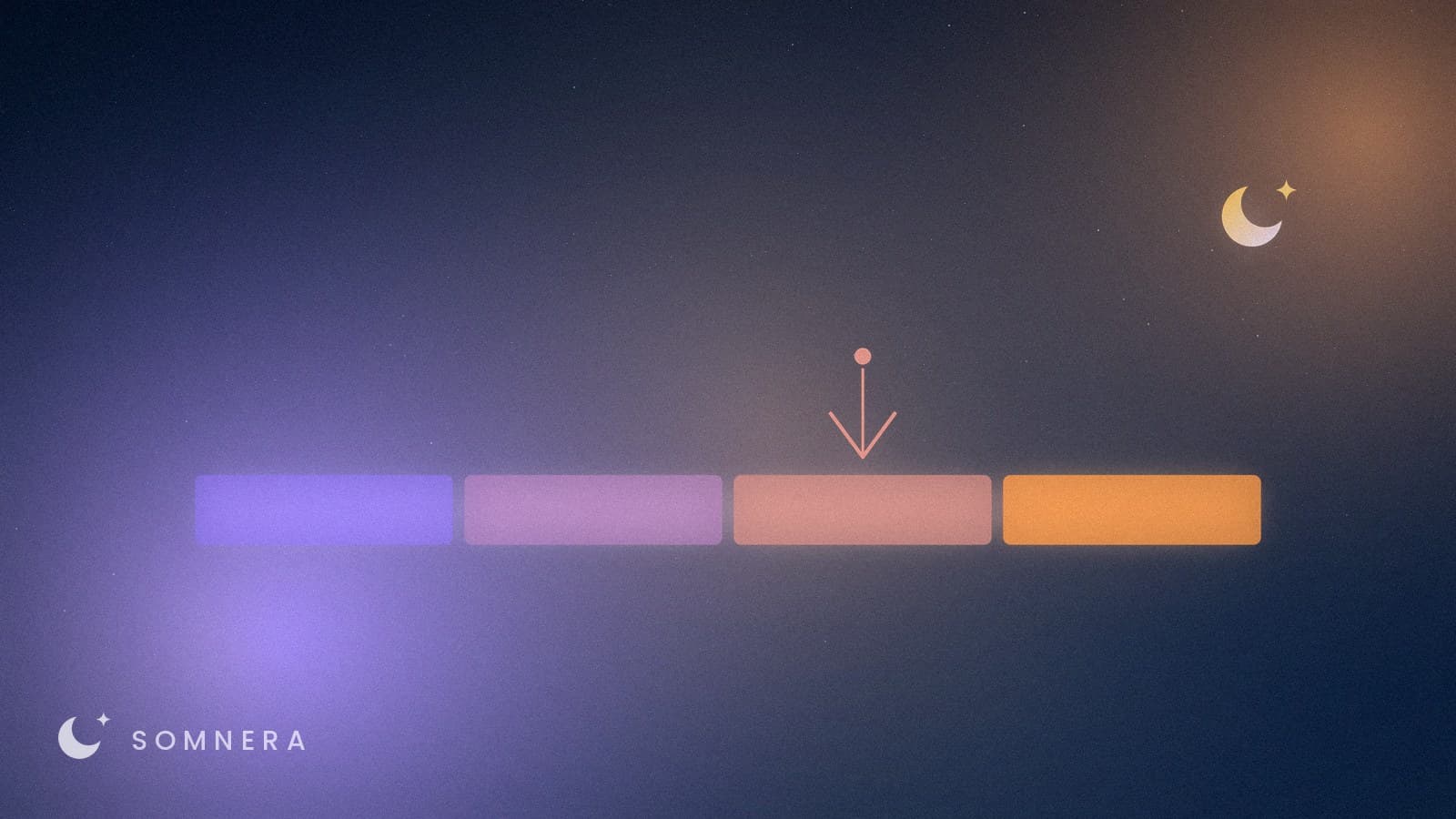
A bar divided into four bands from violet to peach, with a pointer over the third.

Share

The Insomnia Severity Index is a seven-item questionnaire scored from 0 to 28. It takes about two minutes, it is one of the most widely used measures in sleep research, and it is almost certainly the thing you filled in if a sleep program or a clinic asked you a short set of questions before anything else.

What surprises most people is what it asks about. It is not a measure of how much you sleep.

What the seven items actually measure

The instrument was developed by Charles Morin and colleagues, and the version in common use has seven items rated on a five-point scale, each scored 0 to 4. Between them they cover:

  • Difficulty falling asleep.
  • Difficulty staying asleep.
  • Waking too early.
  • How satisfied or dissatisfied you are with your current sleep pattern.
  • How noticeable you think the problem is to other people, in terms of your quality of life.
  • How worried or distressed you are about it.
  • How much it interferes with daily functioning.

Four of those seven are not about the night at all. Satisfaction, noticeability, worry and daytime interference are about what the problem costs you, and they are weighted equally with the sleep-difficulty items.

That design is deliberate, and it is the single most useful thing to understand about the score. Two people can sleep exactly the same number of hours and land in different bands, because insomnia as a disorder is defined by distress and daytime consequence, not by a threshold number of hours. Someone who sleeps five hours and is untroubled by it does not have insomnia. Someone who sleeps six and a half and spends every evening dreading bedtime may well.

The four bands

Scores are summed across the seven items for a total out of 28, and interpreted in four ranges.

0–7: no clinically significant insomnia

The range most people without a sleep complaint fall into. It does not mean flawless sleep — bad nights happen to everyone — but the difficulty is not at a level the measure treats as significant, and it is not costing much in the daytime.

If you scored here and still feel exhausted, that is worth paying attention to rather than dismissing. Persistent daytime sleepiness alongside a low insomnia score points away from insomnia and toward something else, and sleep apnea is the most common candidate.

8–14: subthreshold insomnia

Real difficulty that has not reached the clinical range. This band covers a lot of ground: people early in a problem, people managing it well enough that it has not taken over the day, and people who have had it long enough to have stopped noticing how much they have rearranged around it.

It is also the band where behavioral change tends to be least unpleasant, because there is less to unwind.

15–21: moderate clinical insomnia

The range where the problem is generally described as clinical. Nights are difficult several times a week, the daytime cost is noticeable, and worry about sleep has usually become part of the picture rather than a reaction to it.

This is the band most people arrive at a structured program with.

22–28: severe clinical insomnia

Substantial difficulty with substantial daytime consequence. Worth taking to a clinician rather than working through alone — not because a program is unsafe at this level, but because scores this high more often sit alongside something else that deserves its own attention, whether that is another sleep disorder, a mood disorder, pain, or a medication.
Take the free assessment to see:

  • Your Insomnia Severity Index (ISI) score
  • A personalized 6-week CBT-I plan, built by a sleep physician
  • How your sleep improves, night by night
Start free assessment

What the score does not tell you

It is not a diagnosis, and treating it as one is the most common mistake made with it.

A diagnosis of chronic insomnia disorder involves things a questionnaire cannot establish: how long it has been going on, how many nights a week, whether there is adequate opportunity to sleep in the first place, and whether another disorder explains it better. The ISI captures severity at a moment. It does not rule anything out.

It is also entirely self-reported, which is a feature rather than a flaw — the thing being measured is subjective by definition — but it does mean the score moves with how you feel about your sleep as well as with your sleep. That is worth knowing before reading too much into a two-point change.

And it says nothing about what to do. A high score is not an argument for medication; clinical guidelines put the behavioral approach ahead of medication for chronic insomnia in adults regardless of severity band.

The trend is the useful part

The measure was designed partly to detect change, and that is where it earns its place.

A single score is a snapshot taken on a particular day, in a particular mood, after a particular week. The same questionnaire repeated every few weeks across a program is something else: a line rather than a point, and one you can compare against how you think things are going.

That comparison is often the interesting bit. Insomnia distorts recall — people reliably remember their sleep as worse than a record of it shows. A diary corrects that on the night-by-night scale, and a repeated ISI corrects it across weeks. When the number has dropped six points and the week still felt bad, the number is usually the more accurate of the two.

Every few weeks is frequent enough. Retaking it daily would mostly measure last night.

What to do with a score

If you are taking it to an appointment, it is a useful opening. "I scored 19 on the ISI" is a more precise start than "I'm not sleeping well," and it is a measure your clinician will recognize — which is most of what makes that conversation go somewhere.

If you are deciding whether to start a structured program, the band is less important than the pattern behind it. Three or more bad nights a week for three months or more is the shape that CBT-I was developed for, and what a six-week program involves is worth reading before you begin rather than after.

And if the score is low but the daytime is bad, that mismatch is the finding. It is the case for an appointment, not a program.

When something else is going on

See a clinician rather than working from a score if you snore loudly, wake gasping, or have been told you stop breathing; if your legs feel restless in the evening; if you fall asleep during the day in situations where you would not expect to; if you work shifts; or if this began suddenly or alongside a new medication. The other articles in this section cover what the behavioral approach does and does not address.

Somnera is a self-guided education program built on CBT-I, founded and written by Dr. Camilo Ruiz, DO, FACOI, FAASM. It is not a diagnosis and does not replace care from your own clinician. The assessment is free and gives you a scored result before any payment.

Citations

  • Morin CM, Belleville G, Bélanger L, Ivers H. The Insomnia Severity Index: psychometric indicators to detect insomnia cases and evaluate treatment response. Sleep. 2011;34(5):601–608. doi:10.1093/sleep/34.5.601
  • Bastien CH, Vallieres A, Morin CM. Validation of the Insomnia Severity Index as an outcome measure for insomnia research. Sleep Med. 2001;2(4):297–307. doi:10.1016/s1389-9457(00)00065-4
  • Qaseem A, et al. Management of chronic insomnia disorder in adults: a clinical practice guideline from the American College of Physicians. Ann Intern Med. 2016;165(2):125–133. doi:10.7326/M15-2175
  • Edinger JD, et al. Behavioral and psychological treatments for chronic insomnia disorder in adults: an American Academy of Sleep Medicine clinical practice guideline. J Clin Sleep Med. 2021;17(2):255–262. doi:10.5664/jcsm.8986

Frequently asked questions

A score of 0 to 7 is the band described as no clinically significant insomnia. Most people without a sleep complaint score in that range. It does not mean perfect sleep; it means the difficulty is not at a level the questionnaire treats as significant.

15 and above is the range usually described as clinical insomnia - 15 to 21 moderate, 22 to 28 severe. Between 8 and 14 is subthreshold: real difficulty that has not reached the clinical range. Research studies commonly use a cutoff around 10 or 15 depending on what they are screening for.

No. It is a screening and severity measure, and it is self-reported. A diagnosis of chronic insomnia disorder involves duration, frequency, daytime consequences and the exclusion of other sleep disorders - none of which a seven-item questionnaire can establish on its own.

Every few weeks is enough. It was designed partly to detect change over time, so it is most useful as a trend across a program rather than as a single reading. Taking it nightly would mostly measure how last night went.

No. The score describes severity, not what to do about it. Clinical guidelines put the behavioral approach ahead of medication for chronic insomnia regardless of where someone falls on the scale.