Sleep efficiency is the share of your time in bed that you actually spend asleep, and consolidated sleep is usually above about 85%. For people with insomnia, it is often a more useful number than total hours - and it is the number CBT-I is built to move.
How to work it out
The calculation is simple:
Sleep efficiency = time asleep ÷ time in bed × 100
If you were in bed from 11pm to 7am - eight hours - and asleep for six of them, your sleep efficiency is 6 ÷ 8 = 75%. If you were asleep for seven of those eight hours, it is 87.5%.
The inputs come from a sleep diary: when you got into bed, how long it took to fall asleep, how long you were awake during the night, when you woke for the last time, and when you got up. One night tells you little. A week or two shows a pattern.
What the numbers mean
Above about 85% is generally what consolidated sleep looks like. You fall asleep reasonably quickly, and you do not spend long stretches awake.
Below that, a growing share of your time in bed is spent awake - lying there trying to fall asleep, or awake in the middle of the night. That is the pattern insomnia produces, and it is a pattern the brain learns: the more time spent awake in bed, the more the bed becomes a place for being awake. Why that happens.
Why it matters more than hours
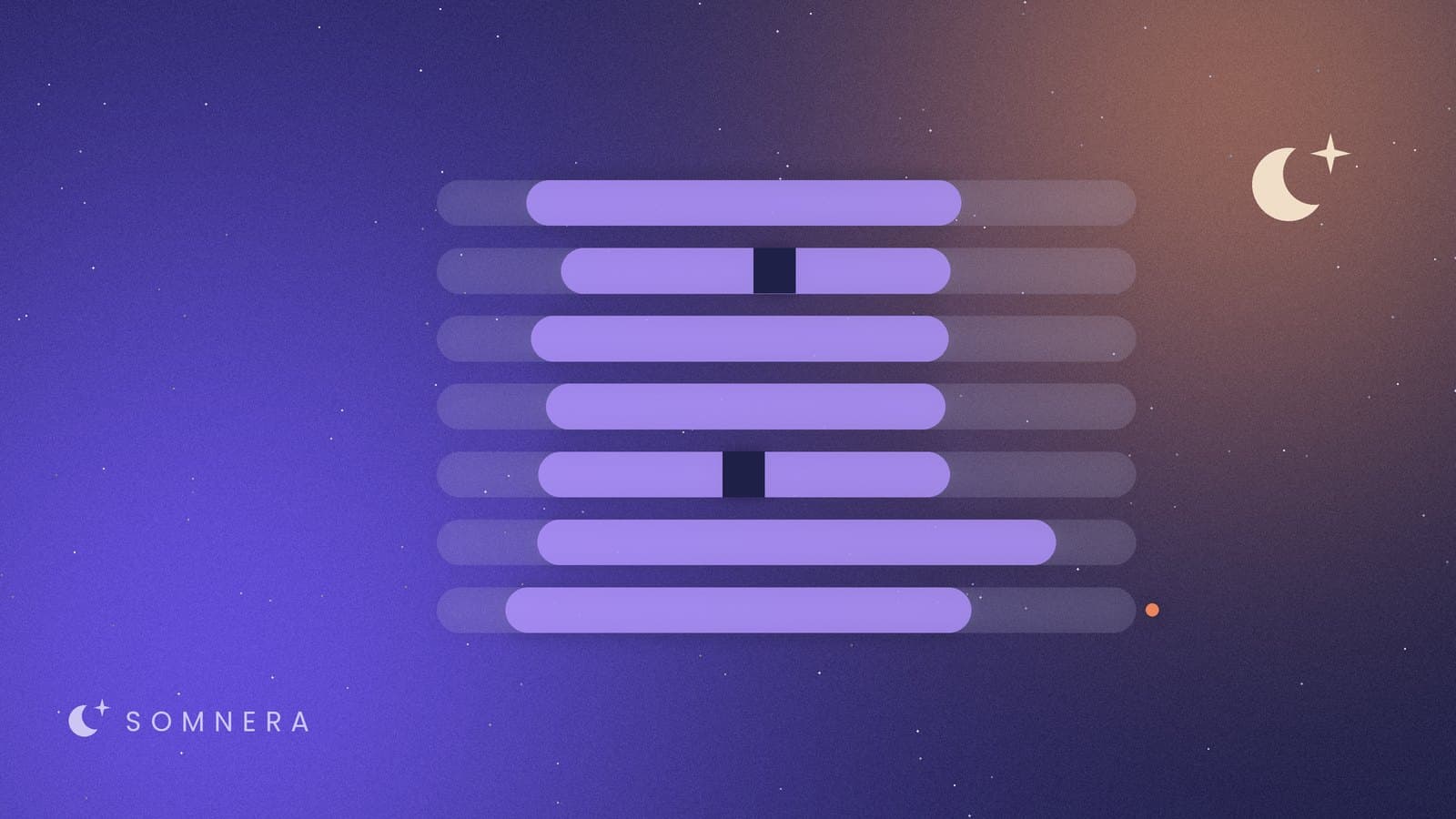
Six hours slept in one block is a completely different night from six hours scattered across nine hours in bed with three long wakings. Same total. Nothing like the same experience, and nothing like the same next day.
This is also why spending more time in bed to "catch up" tends to backfire. If you sleep six hours either way, nine hours in bed gives you a sleep efficiency of 67%, and seven hours in bed gives you 86%. The second night is the better one, even though it looks shorter.