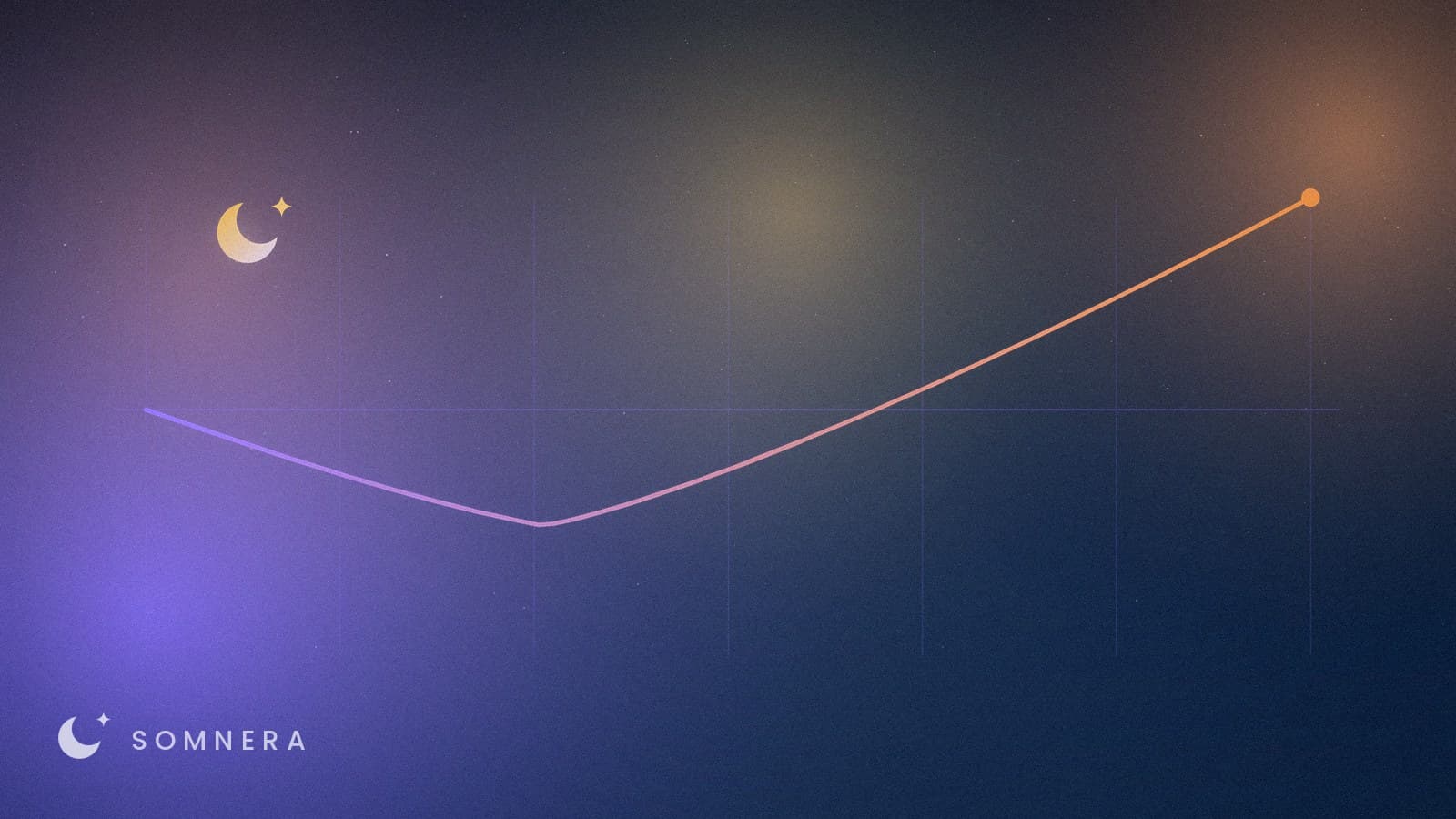
Four to eight weeks in the research, with the change usually appearing somewhere in weeks two to four — after a stretch of feeling worse rather than better.
That last clause is the part that gets left out of most descriptions, and it is the reason a lot of people conclude CBT-I does not work when what actually happened is that they stopped during the phase where it is supposed to feel bad.
The honest timeline
Week one: nothing happens, on purpose
The first week is baseline. You keep a diary and change almost nothing, because the sleep window is calculated from your own numbers and those numbers do not exist yet.
People find this week frustrating. It is also non-negotiable: a window set from a guess is either far too aggressive, which is unpleasant and unsafe, or barely restrictive, in which case nothing shifts.
Week two: the hard one
The window comes in and your time in bed drops to roughly what you have actually been sleeping. Sleep pressure starts building, and in the meantime you are more tired during the day, not less.
This is measured, not anecdotal. Kyle and colleagues found reduced total sleep time, increased daytime sleepiness and objectively impaired vigilance during the restriction phase. It is the mechanism working.
It is also, unsurprisingly, where most people quit — roughly at the point where the approach is doing the thing it does.
Weeks three and four: the first real signal
What usually moves first is not total hours. It is consolidation: falling asleep faster, and less time awake in the middle of the night.
The pooled figures across randomized trials of CBT-I are about 19 minutes faster to fall asleep and about 26 minutes less time awake during the night, with sleep efficiency improving by roughly 10 percentage points. Those describe the method across many people, not a forecast for your particular fortnight.
Notably, total sleep time is the number that moves least — in that same analysis it was not statistically significant. People often sleep a similar amount and experience it completely differently, because six hours slept in one block is not the same night as six hours scattered across nine.
Weeks five and six: widening
As efficiency holds high, the window opens back up in small increments. This is where total sleep tends to increase, and where the gains have to be defended against the urge to widen faster than the data supports.
After: the part that matters most
The strongest argument for CBT-I is not that it is quick. It is that improvements are generally maintained after treatment ends. Nothing is being propped up — you have changed a schedule and a set of associations, and those persist.
That is the comparison clinical guidelines are making when they put it ahead of medication. The American College of Physicians has recommended it as the first-line approach for chronic insomnia in adults since 2016, and the AASM's behavioral guideline reached the same conclusion.