What the evidence shows for each
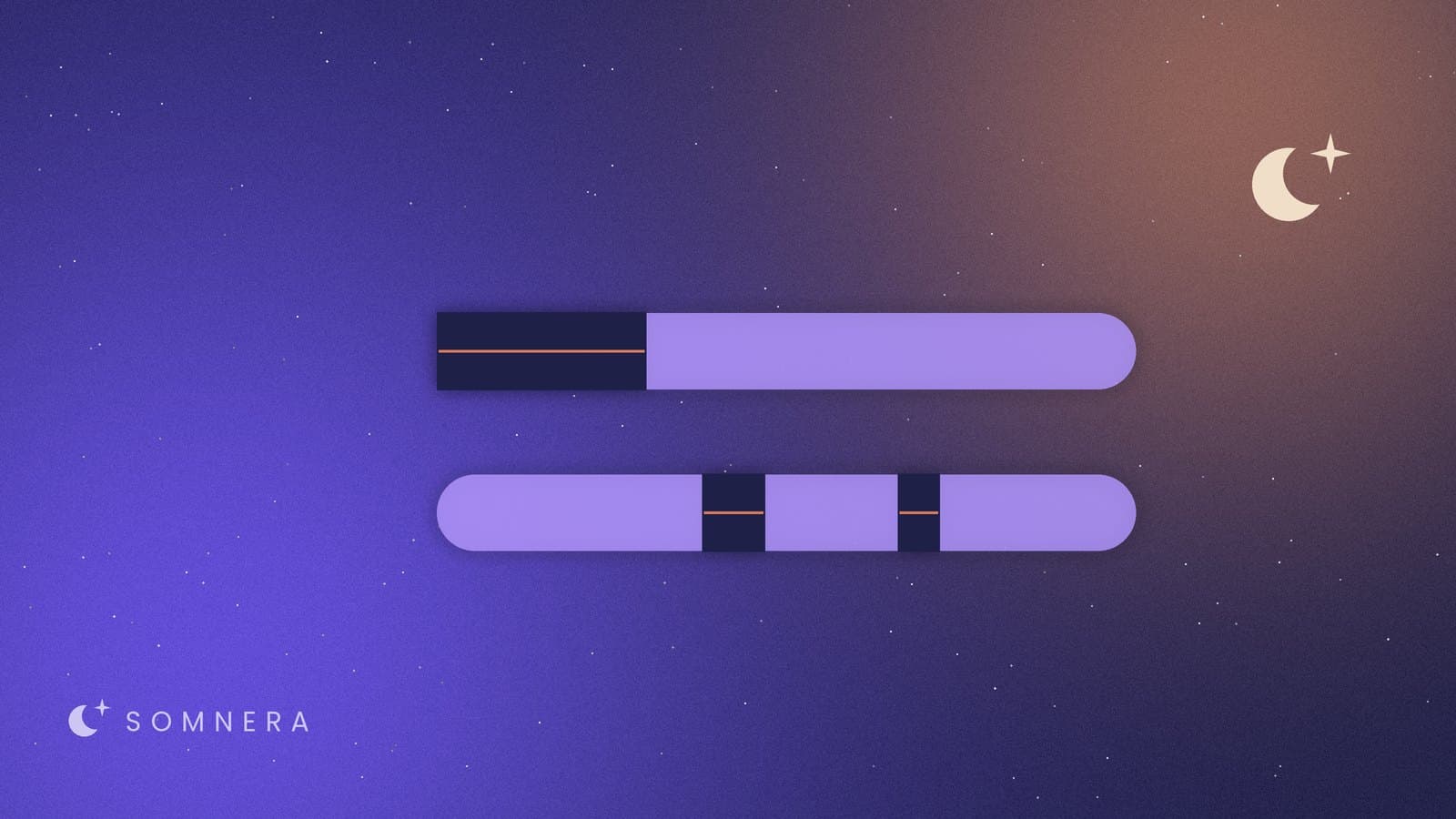
Pooled across randomized trials, CBT-I reduced the time taken to fall asleep by about 19 minutes (95% CI 14.1 to 23.9) and the time spent awake during the night by about 26 minutes (95% CI 15.5 to 36.5). It improved both patterns, with the same treatment.
The waking in the middle of the night
Brief wakings are a normal part of sleep. Everyone surfaces at the end of sleep cycles, and most of the time nobody remembers it. What turns a normal waking into an hour awake is what happens next: noticing, checking the clock, calculating how long is left, and getting frustrated. Why do I wake up at 3am?
When the pattern points elsewhere
The distinction is most useful as a clue that something besides insomnia may be involved:
- Frequent wakings with snoring, gasping or witnessed pauses in breathing can suggest sleep apnea, which needs ruling out. Do you need a sleep study?
- Being unable to fall asleep until very late, and unable to wake until late, regardless of effort can suggest a body clock running late rather than insomnia.
- Waking very early with low mood is worth raising with a clinician. Insomnia and depression.
What to do tonight
Whichever pattern you have, the immediate advice is the same. If you have been awake a while and are getting frustrated, get up and do something quiet elsewhere until you feel sleepy, then go back. Do not check the clock. Get up at your usual time regardless. Can't sleep at 2am?
If it is happening most nights, for months, it is worth treating as a pattern. What CBT-I is, and the rest of this section.
Somnera is a self-guided education program built on CBT-I, founded and written by Dr. Camilo Ruiz, DO, FACOI, FAASM. It is not a diagnosis and does not replace care from your own clinician. The assessment is free and takes about two minutes.
Citations
- Trauer JM, et al. Cognitive behavioral therapy for chronic insomnia: a systematic review and meta-analysis. Ann Intern Med. 2015;163(3):191–204. doi:10.7326/M14-2841
- Morin CM, Belleville G, Bélanger L, Ivers H. The Insomnia Severity Index: psychometric indicators to detect insomnia cases and evaluate treatment response. Sleep. 2011;34(5):601–608. doi:10.1093/sleep/34.5.601
- Edinger JD, et al. Behavioral and psychological treatments for chronic insomnia disorder in adults: an American Academy of Sleep Medicine clinical practice guideline. J Clin Sleep Med. 2021;17(2):255–262. doi:10.5664/jcsm.8986
- Espie CA, et al. The attention–intention–effort pathway in the development of psychophysiologic insomnia: a theoretical review. Sleep Med Rev. 2006;10(4):215–245. doi:10.1016/j.smrv.2006.03.002
- Kapur VK, et al. Clinical practice guideline for diagnostic testing for adult obstructive sleep apnea: an American Academy of Sleep Medicine clinical practice guideline. J Clin Sleep Med. 2017;13(3):479–504. doi:10.5664/jcsm.6506